
In the field of optical measurement and spectral detection, the central wavelength and measurement range are two critical parameters determining an instrument's suitability, stability, and measurement accuracy. However, in practical applications, many users misunderstand their definitions, distinctions, and selection criteria; some believe that "only the central wavelength provides accurate measurements," while others prioritize a "wider measurement range is always better." This article systematically elucidates the true meanings of central wavelength and measurement range from a professional technical perspective, helping users develop a scientific and accurate understanding.
I. Central Wavelength: The Optimal Response Reference for Optical Sensors
The central wavelength refers to the characteristic wavelength at which the photoelectric detection device exhibits the highest response efficiency, most stable signal output, and optimal measurement linearity during factory design and spectral response calibration. It is determined by the intrinsic properties of the photosensitive material, the optical filtering system, the chip structure, and the packaging process, representing the optimal operating point at the physical level of the sensor.
At the central wavelength, the instrument achieves: ① optimal signal response; ② superior measurement stability; ③ maximum data consistency; and ④ ideal long-term reliability. In simple terms, the central wavelength represents the instrument's "optimal operating condition."
The central wavelength is not a limiting factor but rather the optimal reference point for device performance, guiding users in selecting the measurement scheme best suited to their specific application.
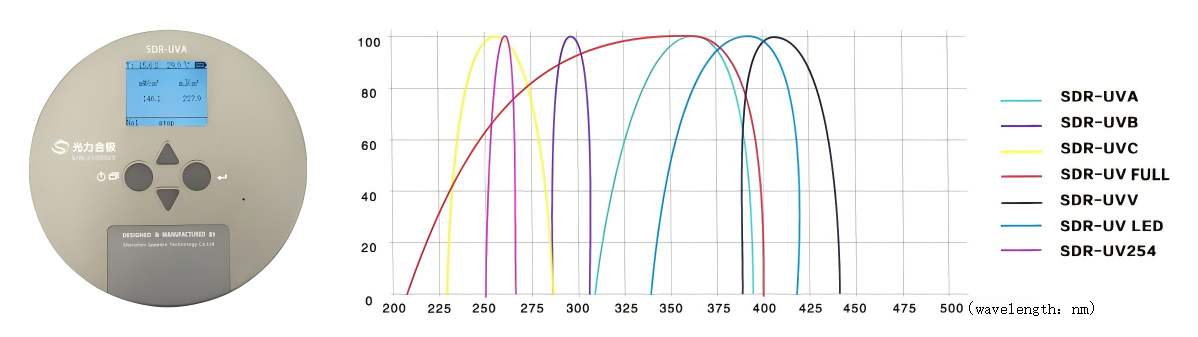
UV Energy Meter Spectral Response Curve
II. Measurement Range: The effective working interval ensuring accuracy
The measurement range refers to the spectral interval within which the instrument, after rigorous calibration, spectral compensation, and factory verification, can perform effective, accurate, and reliable measurements. Within this range, the equipment has undergone full-band linear correction and error calibration, ensuring compliance with its nominal technical specifications. This means that as long as the target wavelength falls within the specified measurement range, the measurement results are accurate and valid.
The significance of the measurement range lies in defining the applicable boundaries of the device. It informs users that within this range, the instrument operates stably, yields reliable data, and produces traceable results; beyond this range, neither accuracy nor validity can be guaranteed.
The measurement range determines whether the instrument is "operational," not its "accuracy."
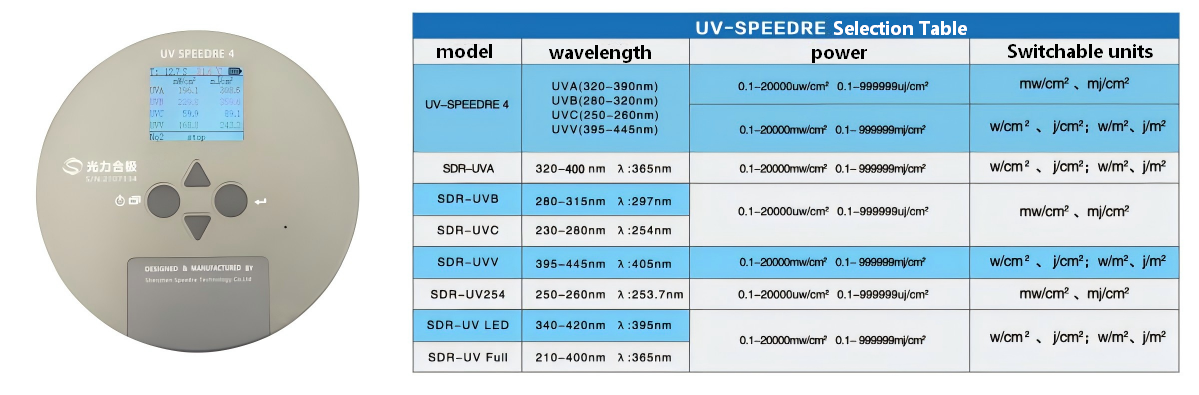
UV Energy Meter Measurement Range
III. Clarifying the Core Misconception: Central Wavelength = The Only Accurate Wavelength
The most common misconception in the industry is: "The instrument measures accurately only at the central wavelength; data become unreliable when deviating from this wavelength." From a professional technical perspective, this view is invalid.
The central wavelength determines optimal performance, while the measurement range ensures effective accuracy. These two factors are not mutually exclusive but rather hierarchical: ① Within the measurement range: all wavelengths can be measured accurately; ② At the central wavelength: the instrument achieves optimal response, stability, and consistency.
In other words: all wavelengths within the specified range are acceptable, with the central wavelength being optimal. Deviation from the central wavelength does not cause measurement failure; however, the device cannot achieve its theoretical peak performance.
IV. Technical Value and Application Scenarios of a Wide Measurement Range
Many users ask: Since the center point offers optimal performance, why is a wide measurement range designed?
In fact, a wide measurement range is not designed to enhance accuracy, but rather to ensure versatility, compatibility, and flexibility across various applications. The core value of a wide measurement range lies in: ① Multi-light-source compatibility: A single device can accommodate light sources with different wavelengths, reducing redundant investments. ② Adaptability to complex operating conditions: Suitable for scenarios such as production lines with variable wavelengths, shared workstations, and broad-spectrum testing in laboratories. ③ Enhanced equipment flexibility: Meeting the ongoing operational needs following future process upgrades or light-source replacements.
In summary: Wide range = greater versatility; Central alignment = optimal performance. Both serve different requirements; there is no inherent superiority or inferiority between them, only differences in suitability.
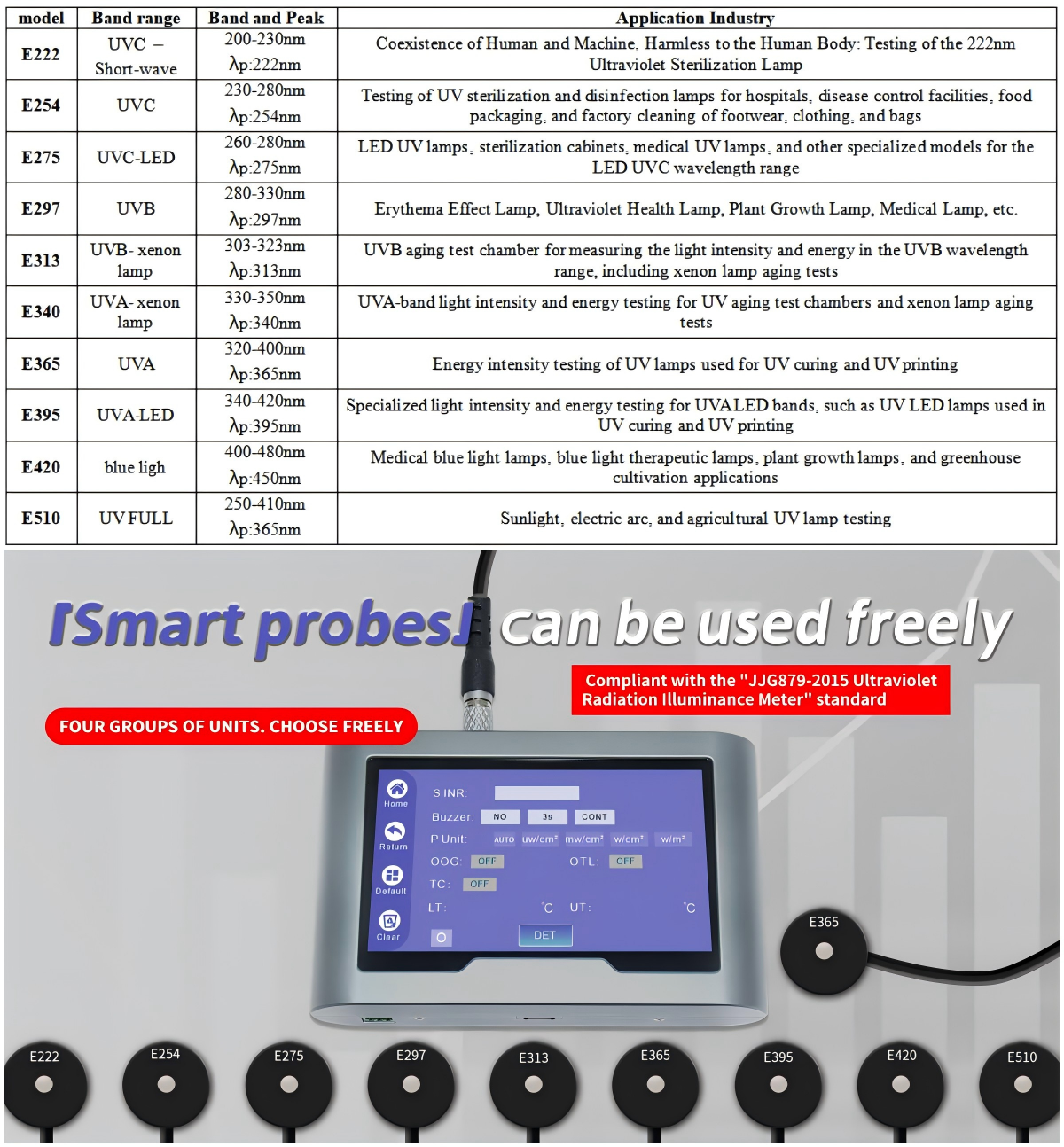
Ultraviolet Irradiometer Selection Table
V. Scientific Instrument Selection: How to Choose the Most Suitable Instrument?
Based on the technical logic of central wavelength and measurement range, professional selection should adhere to the following principles:
① Fixed wavelength, high-precision detection
lPrioritize instruments whose central wavelength closely matches the target light source.
lApplicable to: fixed-line production inspection, quality control, high-precision calibration, and long-term stability monitoring.
lAdvantages: High data consistency, strong stability, and minimal errors.
② Multi-wavelength, universal detection
lSelect models with a wide measurement range and position the commonly used wavelengths as close as possible to the central region.
lApplicable to: multi-light-source sharing, laboratory R&D, temporary testing, and scenarios with variable wavelengths.
lAdvantages: High versatility, broad applicability, and lower operating costs.
Key selection conclusions: The measurement range determines the usability of the device, while the central wavelength dictates the quality of measurements. For precise detection, prioritize compatibility; for general applications, focus on the measurement range.
The central wavelength and measurement range are the two most fundamental and critical parameters of optical detection instruments. The measurement range ensures measurement effectiveness, while the central wavelength determines measurement optimality. Only by fully understanding the definitions and relationship between these two parameters can one avoid selection pitfalls, enable the equipment to deliver optimal performance, and achieve truly stable, reliable, and precise optical detection.
Professional measurement begins with precise understanding and stems from scientific alignment.